
Survey Led Office WiFi 7: RUCKUS R770 and ICX 8200 Deployment in a Concrete Heavy Building
Designed around real world RF; not an idealized floor plan.
Modern office WiFi is business infrastructure. Cloud applications, video meetings, mobile workstations, guest access, collaboration platforms, IoT devices, and everyday operations all depend on reliable Wireless Internet.
For the Situation Group, the goal was not simply to install newer or faster access points. The goal was to build a secure, reliable, centrally manageable permanent WiFi network designed around how the building actually behaves.
That distinction mattered.
The office included concrete signal blockers, enclosed rooms, stairwells, elevator areas, structural cores, and interior spaces where reliable WiFi coverage could not be assumed from a floor plan.
Slice Wireless Solutions approached the project the same way we approach complex permanent wireless deployments: survey first, engineer around the RF environment, install precisely, and validate the finished network.
The project included a professional wireless site survey, RF-based network design, eight RUCKUS R770 WiFi 7 access points, RUCKUS ICX 8200 switching, installation and configuration, and post installation testing.
Why couldn’t this office WiFi network be designed from the floor plan alone?
Floor plans show walls, rooms, hallways, stairwells, and equipment areas. They do not show exactly how radio frequency energy will behave inside the finished building.
That is especially important in concrete heavy environments.
Concrete, brick, metal, elevator shafts, structural cores, coated glass, and other construction materials can significantly attenuate wireless signals. Industry planning references, for example, estimate concrete or brick attenuation around 12 dB ±6 dB at 2.4 GHz and 20 dB ±10 dB at 5 GHz; but actual losses vary considerably based on material thickness, composition, moisture, reinforcement, and the building itself.
WiFi 7 also introduces extensive use of the 6 GHz spectrum. That creates major opportunities for additional capacity and high speed connectivity, but it makes proper access point placement even more important in environments with substantial physical obstructions.
For that reason, Slice does not treat a drawing as a substitute for RF data.
A professional WiFi and RF site survey helps determine how signals propagate through the actual environment, where interference exists, which building materials create problems, and where access points should be positioned to serve users effectively.
For Situation Group, the design principle was straightforward:
Design for the RF environment, not just the drawing.
Instead of attempting to push maximum transmit power through concrete walls, the network was designed around properly positioned wireless cells serving the spaces where employees and devices actually connect.
How did the wireless site survey shape the WiFi 7 deployment?
The RF site survey became the foundation of the project.
Slice’s site survey process evaluates the wireless environment before final equipment placement, helping identify interference, building-material characteristics, access-point positioning, cabling considerations, and other factors that can affect network performance.
For this office, the survey led process included:
Mapping concrete heavy areas and significant structural RF blockers
Reviewing enclosed offices, conference rooms, stairwells, and elevator areas
Evaluating open office areas and higher density work zones
Identifying access point locations that could provide strong coverage without unnecessary overlap
Planning channel use and transmit power
Considering roaming between wireless cells
Designing for both coverage and capacity
Identifying logical cabling and equipment locations
Planning around the actual applications and devices employees would use
Those findings could then be incorporated into an engineering plan before final deployment.
This is particularly important for large area WiFi and complex commercial networks.
A strong wireless network is not created by making one access point as powerful as possible. It comes from creating predictable wireless cells with appropriate signal quality, capacity, channel separation, and overlap.
Users should be able to move through the office without having to think about which access point they are connected to.
That experience starts with RF engineering.
Why did Slice select the RUCKUS R770 for the WiFi 7 layer?
Slice Wireless Solutions is hardware-neutral. The objective is to select the equipment that fits the project rather than force every building into the same hardware design.
For this deployment, the RUCKUS R770 provided the WiFi 7 capabilities and RF features suited to the office environment.
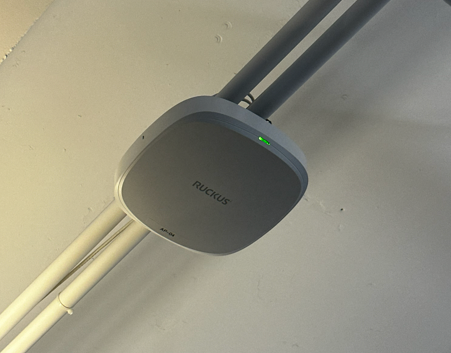
Key R770 capabilities include:
Tri-band WiFi across 2.4 GHz, 5 GHz, and 6 GHz
Wi-Fi 7 / IEEE 802.11be support
Multi-Link Operation and other WiFi 7 capabilities
Eight spatial streams: 2x2:2 at 2.4 GHz, 4x4:4 at 5 GHz, and 2x2:2 at 6 GHz
A combined maximum PHY rate of 12.22 Gb/s
BeamFlex adaptive antenna technology with thousands of antenna patterns per band
A multigigabit 1/2.5/5/10 GbE Ethernet interface for high-speed wired backhaul
Eight RUCKUS R770 access points were positioned according to the office’s actual coverage and capacity requirements.
The important part of that sentence is not simply “eight access points.”
The important part is where those eight access points were installed and why.
Adding more APs does not automatically create a better network. Poorly positioned access points can create excessive overlap, co-channel interference, inconsistent roaming, and unnecessary cost.
The site survey and engineering process allowed Slice to determine where the R770s could most effectively serve employees, guests, conference rooms, work areas, and connected devices.
The objective was not just to turn on WiFi 7.
It was to make WiFi 7 useful throughout the actual office.
Why did the RUCKUS ICX 8200 switching infrastructure matter?
Wireless performance does not stop at the access point.
A modern WiFi 7 access point needs an appropriately designed wired network behind it. Without sufficient power, multigigabit connectivity, switching capacity, and uplink performance, the wired edge can become the bottleneck.
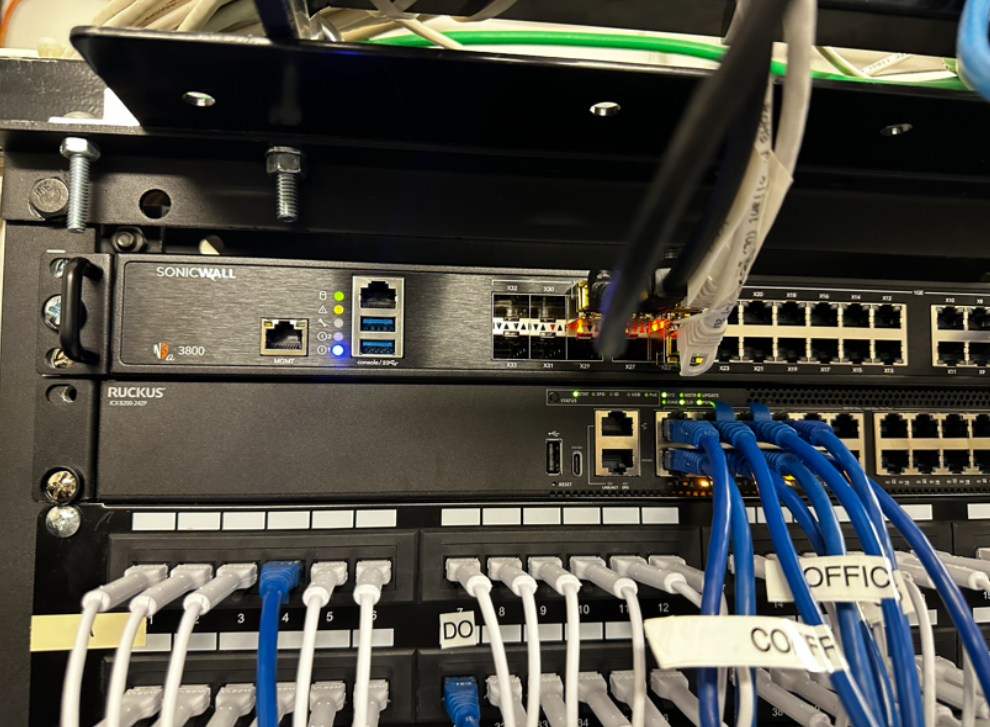
The RUCKUS ICX 8200 family was selected to provide the access-layer foundation behind the R770 deployment.
Depending on model and configuration, the ICX 8200 platform supports capabilities such as:
Multigigabit Ethernet connectivity
PoE+ and PoE++ for modern access points and connected devices
High-speed uplinks and stacking
Enterprise switching and Layer 3 capabilities
Scalable management
Support for next-generation WiFi and IoT deployments
Those capabilities are important because a WiFi 7 upgrade should be treated as an end to end network project; not simply an access-point replacement.
Slice can incorporate switching, access points, cabling requirements, network hardware, and related equipment into the overall design and network procurement process so the wireless and wired layers are engineered together.
For Situation Group, the result was a balanced architecture: RUCKUS R770 access points delivering the WiFi 7 wireless layer, supported by RUCKUS ICX 8200 switching providing the wired connectivity and power foundation behind it.
What happens after the permanent WiFi system is installed?
A permanent business network also needs to remain reliable after the installation team leaves.
Slice offers managed Wi‑Fi services and network operations and monitoring for organizations that want ongoing visibility into their wireless infrastructure.
Monitoring can help identify outages, anomalies, performance changes, and other issues before they turn into persistent user complaints.
For organizations managing larger or more complex wireless environments, Slice can also incorporate WiSNET unified wireless management to provide centralized visibility and control across wireless devices and services.
That turns the deployment from a one-time hardware project into infrastructure that can be actively operated, monitored, and adapted as requirements change.
What is the biggest lesson from this office WiFi 7 deployment?
WiFi 7 can provide significant performance and capacity improvements, but new hardware does not eliminate the fundamentals of wireless engineering.
Buildings still matter.
Concrete walls matter.
Elevator cores matter.
Conference-room density matters.
AP placement matters.
Cabling and switching matter.
And the applications, devices, and people using the network matter most.
That is why a professional wireless site survey and RF site survey remain essential when planning permanent WiFi, especially in offices with substantial structural obstructions.
The best office Wireless Internet systems are not designed around ideal floor plans or maximum advertised access point range.
They are designed around real RF behavior, implemented with the right wired and wireless infrastructure, and validated after installation.
For Situation Group, that meant combining survey-led RF engineering with eight RUCKUS R770 WiFi 7 access points and RUCKUS ICX 8200 switching to create a network designed around the office as it actually operates.
For organizations planning an office WiFi upgrade, permanent WiFi deployment, large area WiFi network, or transition to WiFi 7, the process should begin before any access points are ordered:
Survey first. Engineer intelligently. Select the right equipment. Install precisely. Validate the network. Monitor it over time.
Planning a new office WiFi network or upgrading an existing system?
Contact Slice Wireless Solutions to schedule a wireless assessment.