
WiFi 6 vs. WiFi 6E vs. WiFi 7: Which Wireless Internet Standard Is Right for Your Network?
Wireless Internet is no longer just a convenience. Businesses, venues and event organizers depend on WiFi for video calls, mobile payments, cloud applications, guest access, event check-in, security systems, inventory scanners, livestreaming and connected devices.
Choosing between WiFi 6, WiFi 6E and WiFi 7, however, is not as simple as purchasing the newest access point.
The right wireless standard must be matched to the building or event site, the number and type of devices, the available Internet backhaul, the wired network, the coverage area and the organization’s operational goals. A network that works well in a small office may not be appropriate for a warehouse, airport, festival, boardwalk or crowded public venue.
At Slice Wireless Solutions, we design temporary and permanent wireless networks around real operating conditions—not theoretical maximum speeds.
What is the main difference between Wi-Fi 6, Wi-Fi 6E and Wi-Fi 7?
The simplest comparison is:
WiFi 6 improves efficiency. It helps networks serve more devices effectively on the established 2.4 GHz and 5 GHz bands.
WiFi 6E adds cleaner spectrum. It extends WiFi 6 into the 6 GHz band for compatible access points and client devices.
WiFi 7 increases performance and flexibility. It introduces wider channels, Multi Link Operation and other improvements designed for higher throughput, lower latency and greater reliability.
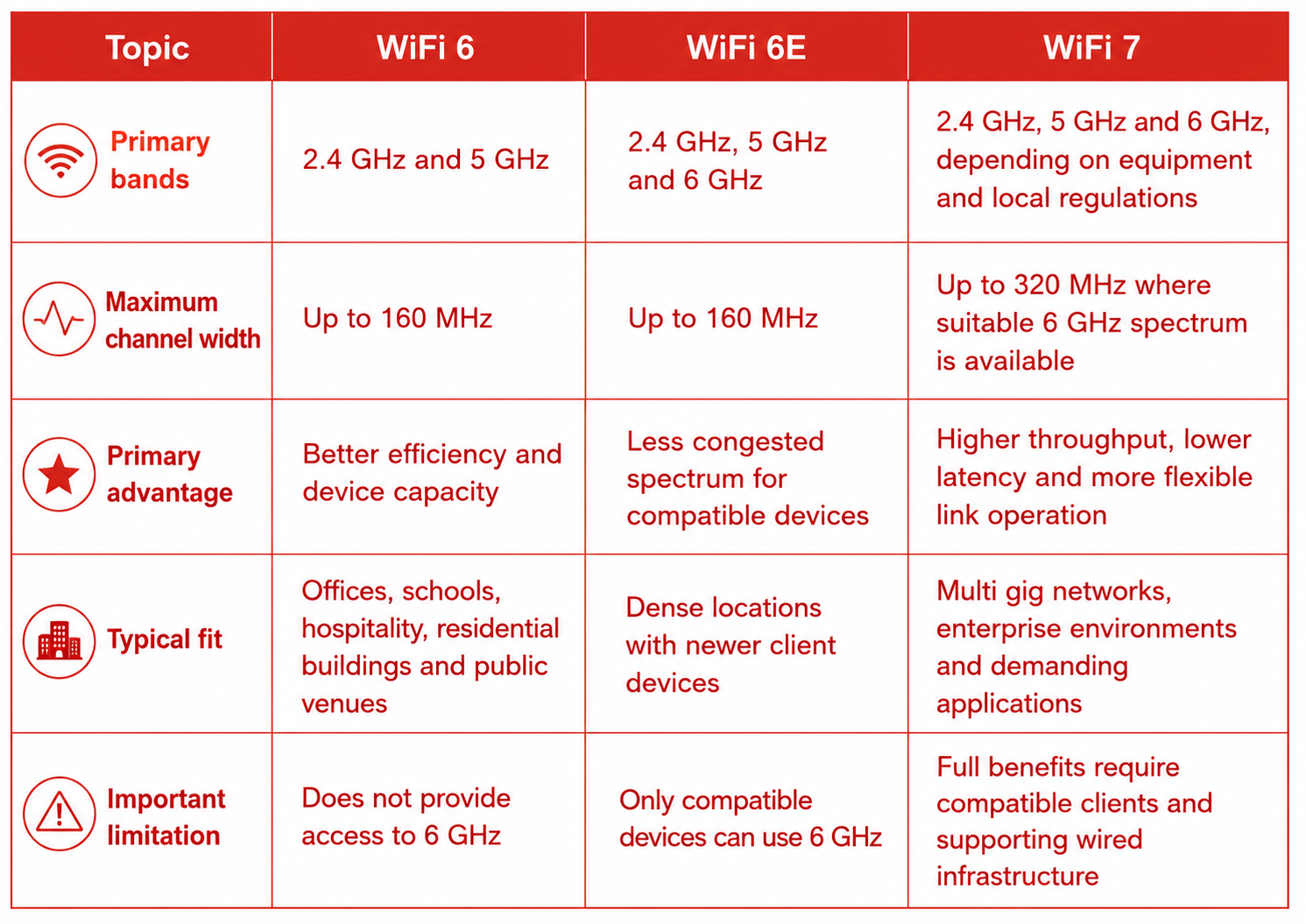
When is WiFi 6 the best choice?
WiFi 6 remains a practical and cost effective choice for many business and public networks.
It was designed to improve how efficiently an access point communicates with multiple devices, making it particularly valuable in offices, classrooms, hospitality spaces, apartment buildings, healthcare facilities and other environments where numerous users share the network.
Important WiFi 6 technologies include:
OFDMA, which divides a channel into smaller resource units so multiple devices can be served more efficiently.
MU MIMO, which allows an access point to communicate with multiple compatible devices simultaneously.
Target Wake Time, which can reduce unnecessary activity for battery powered and IoT devices.
Beamforming, which helps direct wireless energy toward connected devices.
WiFi 6 is often the right baseline for a permanent managed WiFi network because it combines broad client compatibility with better capacity than older WiFi 4 and WiFi 5 systems.
It is especially appropriate when:
The organization has a large mix of new and older devices.
Reliable everyday performance matters more than peak benchmark speeds.
The available Internet connection is below multi gigabit speeds.
The budget must cover cabling, switching, installation and management—not only access points.
Wide 5 GHz and 6 GHz coverage would require more access points than the project can support.
When does WiFi 6E make sense?
WiFi 6E uses the same core technology as WiFi 6 but extends further into the 6 GHz band.
Because older WiFi generations do not operate in that band, 6 GHz can give compatible devices access to cleaner spectrum and more room for wide channels. This can be valuable in environments where 5 GHz is crowded by neighboring businesses, tenants, residential networks or event infrastructure.
WiFi 6E may be a strong fit for:
Newer laptops, phones and tablets that support 6 GHz.
Video conferencing and hybrid workspaces.
Dense offices, dormitories and residential buildings.
Media production and large file transfers.
AR and VR applications.
Dedicated high-performance zones.
Wireless mesh backhaul where nodes have a strong 6 GHz connection.
However, adding 6 GHz does not automatically improve every part of a property.
A 6 GHz signal will generally have less usable reach through walls and other obstructions than a comparable lower frequency signal. Concrete, metal, glass, equipment racks, elevation changes and long distances can further affect results.
That is why a professional wireless site survey and network design should be completed before assuming that a WiFi 6E design will cover the same footprint as an existing 5 GHz network.
In many deployments, 6 GHz works best as a high capacity layer for newer devices while 5 GHz and 2.4 GHz continue to provide broader coverage and support legacy equipment.
Why is WiFi 7 important for high performance wireless internet?
WiFi 7 is designed for networks that require greater throughput, lower latency and more reliable use of available spectrum.
Its most important capabilities include:
Channels up to 320 MHz, providing much wider data paths in the 6 GHz band where the required spectrum is available.
Multi Link Operation, which allows compatible devices to use multiple wireless links to improve throughput, latency or resiliency.
4K QAM, which can transmit more data under excellent signal conditions.
Multi RU support, which gives the network more flexibility when assigning spectrum resources.
Improved interference handling, including more flexible use of a wide channel when part of it is affected by interference.
WiFi 7 may be appropriate for:
Premium business and enterprise networks.
High-density venues and public spaces.
Multi gigabit Internet services.
High capacity media and creative workflows.
Advanced wireless mesh deployments.
Industrial and operational technology applications.
AR, VR and XR environments.
Networks being designed for a long replacement cycle.
The access points are only one part of a WiFi 7 project. To benefit from the standard, the deployment may also require multi gigabit switches, suitable cabling, sufficient Power over Ethernet, compatible firewalls, high capacity backhaul and WiFi 7 client devices.
Installing WiFi 7 access points on an older one gigabit wired network may improve some wireless behavior, but it can also leave the network bottlenecked elsewhere.
How should businesses choose among the three standards?
The best standard is the one that supports the actual operational requirement.
Choose WiFi 6 when:
Broad device compatibility is important.
The network supports standard business applications and guest access.
The organization needs a dependable, budget conscious upgrade.
Existing switching and Internet service do not justify a full multi gig refresh.
Coverage and capacity are more important than the highest possible client speed.
Choose WiFi 6E when:
A meaningful percentage of client devices support 6 GHz.
The 5 GHz environment is congested.
High performance users can be concentrated in specific rooms or zones.
The organization needs additional spectrum but is not ready for a full WiFi 7 deployment.
Choose WiFi 7 when:
The network is being built or refreshed with multi gig infrastructure.
Low latency and high throughput are important.
New client devices will support WiFi 7.
The network must remain in place for several technology cycles.
The environment has demanding enterprise, production or high density requirements.
A mixed design may be the most effective solution. WiFi 6 can provide general coverage, while WiFi 6E or WiFi 7 serves high performance areas. Wired Ethernet can still be used for fixed, mission critical equipment such as servers, production encoders, cameras and point of sale stations.
Which standard is best for permanent business WiFi?
For a permanent installation, Slice evaluates more than the wireless generation.
A complete design should consider:
The number and location of users.
Device types and client capabilities.
Application and bandwidth requirements.
Building materials and RF obstructions.
Existing access points and neighboring networks.
Cabling, switch and power availability.
Security and network segmentation.
Roaming requirements.
Monitoring and support.
Future expansion plans.
WiFi 6 remains sufficient for many standard offices and commercial facilities. WiFi 6E can add capacity for newer devices, while WiFi 7 is increasingly appropriate for complex and large scale deployments that are future ready and long life installations.
Slice’s managed WiFi services can cover the process from survey and engineering through procurement, installation, monitoring and ongoing network operations.
Can a WiFi deployment become a cost recovery network?
Yes! WiFi does not always have to remain a pure operating expense.
Venues, event sites, and public properties may be able to offset network costs through sponsored access, premium bandwidth, exhibitor packages, advertising, vendor connectivity or other service fees.
A cost recovery network may include:
Free and premium guest WiFi tiers.
Sponsored login and splash pages.
Exhibitor Internet packages.
Vendor and point of sale connectivity.
Premium service for media and production teams.
Branded captive portals.
Usage and engagement reporting.
Bandwidth controls for different users or groups.
Slice’s FREEMIUM™ WiFi programs can combine free basic access with premium connectivity, sponsorships, advertising and audience engagement opportunities.
For more advanced environments, the WiSNET™ wireless management platform can provide centralized network visibility, traffic controls, reporting and revenue-generation capabilities.
Cost recovery should be considered during the original planning process. Retrofitting payment tiers, portals and network segmentation after installation is usually more complicated than designing them into the deployment from the beginning.
What is the bottom line recommendation?
WiFi 6 is still an effective standard for many permanent business and public networks. It offers improved capacity, efficiency and broad compatibility without requiring every device to support 6 GHz.
WiFi 6E adds a cleaner 6 GHz layer for compatible devices. It can be highly valuable in congested environments, provided the access points are positioned to account for the different coverage characteristics of 6 GHz.
WiFi 7 offers the strongest performance potential through wider channels, Multi Link Operation and other improvements. Its value is greatest when the clients, cabling, switches, power and Internet backhaul are capable of supporting it.
In practical terms:
A standard office or facility may be well served by Wi-Fi 6.
A congested location with newer devices may benefit from WiFi 6E.
A premium, high density or future focused network may justify WiFi 7.
A large venue may need a combination of all three, supported by wired infrastructure and careful RF engineering.
The most important decision is not selecting the newest access point. It is designing the right network for the people, devices, applications and physical environment.
Slice Wireless Solutions provides permanent WiFi, temporary wireless for events, large-area WiFi, managed services, RF site surveys and cost-recovery network design from New York City to locations nationwide.
Schedule a free consultation with Slice Wireless Solutions to discuss the right wireless standard and network design for your location or event.